Sudoku is a logic puzzle with numbers. The playing field is a grid of 9×9 cells, divided into nine boxes of 3×3 cells each. Some cells are already filled in; these are the givens. Your task is to fill the empty cells so that, in the end, all three rules are met.
The three Sudoku rules
- Every row contains the digits 1 to 9 exactly once.
- Every column contains the digits 1 to 9 exactly once.
- Every box of 3×3 cells contains the digits 1 to 9 exactly once.
There are no more rules. The givens stay in place, and a good Sudoku has exactly one solution.
How the grid is built
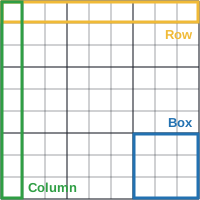
The 81 cells form nine horizontal rows and nine vertical columns. Thick lines divide the grid into the nine boxes. Row, column, and box are together called units: every cell belongs to exactly one row, one column, and one box, and its digit may appear only once in each of these three units.
How many digits are given depends on the puzzle. More givens don’t automatically make a Sudoku easier: how hard it is depends on the techniques you need to solve it. You’ll find more on this under difficulty levels.
Example: which digit belongs in the cell?
The grid below asks for the cell in the middle. Its row already contains 1, 3, and 8, its column 2, 6, and 9, its box 4 and 5. So eight of the nine digits already appear in its units. Only the 7 is missing, so the 7 belongs in the cell. That is how every Sudoku works: you rule out what the rules don’t allow until only one possibility is left.
What isn’t part of the rules
- Calculating: The digits are just symbols. Letters could stand in place of 1 to 9, which is why there is also Letter Sudoku.
- Guessing: A good Sudoku can be solved by logic alone. If you guess and turn out to be wrong, you often have to go back many steps.
- Pencil marks: Small notes of the digits that are still possible (candidates) are allowed and a big help. They are not part of the solution.
Rules of the Sudoku variants
Variants keep the basic rule, each symbol exactly once per unit, and change the playing field:
- Jigsaw Sudoku (Irregular Sudoku): Instead of the 3×3 boxes, there are irregularly shaped regions of nine cells each. In each region, too, every digit appears exactly once.
- Samurai Sudoku: Five 9×9 grids overlap in the corners. The normal rules apply to each sub-grid; the shared boxes belong to two grids at once.
- Super Sudoku: larger grids such as 16×16 with 4×4 boxes and the numbers 1 to 16, each exactly once per row, column, and box.
- Sudoku for kids: small grids with 4×4 or 6×6 cells and the digits 1 to 4 or 1 to 6.
The Sudoku variants page shows all variants at a glance.
What to do next
How to solve a Sudoku from start to finish is shown by the Sudoku guide, using a real puzzle in 49 steps. The solving techniques explain the most important techniques, and if you get stuck somewhere, the Sudoku Solver shows the next step with the reason. New puzzles are available to print and to play.
Playing online
Every Sudoku here can also be solved right on the screen, on a computer, tablet, or phone, free, no sign-up needed. Open one of the online Sudoku pages, pick a level, and start.
Entering digits
On a computer, click a cell or move to it with the arrow keys, then type a digit from 1 to 9; 0 or Delete clears it. On a phone or tablet, tap a cell and choose the digit on the number pad below the grid. It also works the other way round: tap a digit first (it stays active), then tap every cell it belongs in.
With Notes mode switched on, digits go in as small pencil marks instead of answers, which is handy for keeping track of candidates. Highlight matching numbers shows every cell that already holds the digit you selected. On a keyboard, N switches notes on and off, Ctrl+Z and Ctrl+Y undo and redo, and Esc clears the selection.
Help when you get stuck
- Check marks digits that conflict with the rest of the grid.
- Hint fills in one more correct digit.
- Auto candidates writes every digit that is still possible into each empty cell as a pencil mark.
- Show solution reveals the whole grid.
- Undo and Redo take you back and forward through your moves.
Use as much help as you like. The timer only shows how long you took, and Pause stops it and hides the board until you come back.
Levels, new puzzles, and printing
The stars above the grid choose one of six levels, from very easy to extreme. New puzzle loads a fresh puzzle at the same level, and Clear resets the grid to its starting digits. The Daily Sudoku has new puzzles every day for each level; the date, level, and puzzle number are part of the address, so a copied link opens exactly that puzzle. Prefer pencil and paper? The Print this exact puzzle link below the grid turns the puzzle you are playing into a PDF.
The whole board works with the keyboard alone and is labelled for screen readers. The Show larger text button (the Aa symbol at the top of every page) makes the text bigger on all pages.
Found a mistake in the translation? Improve this translation